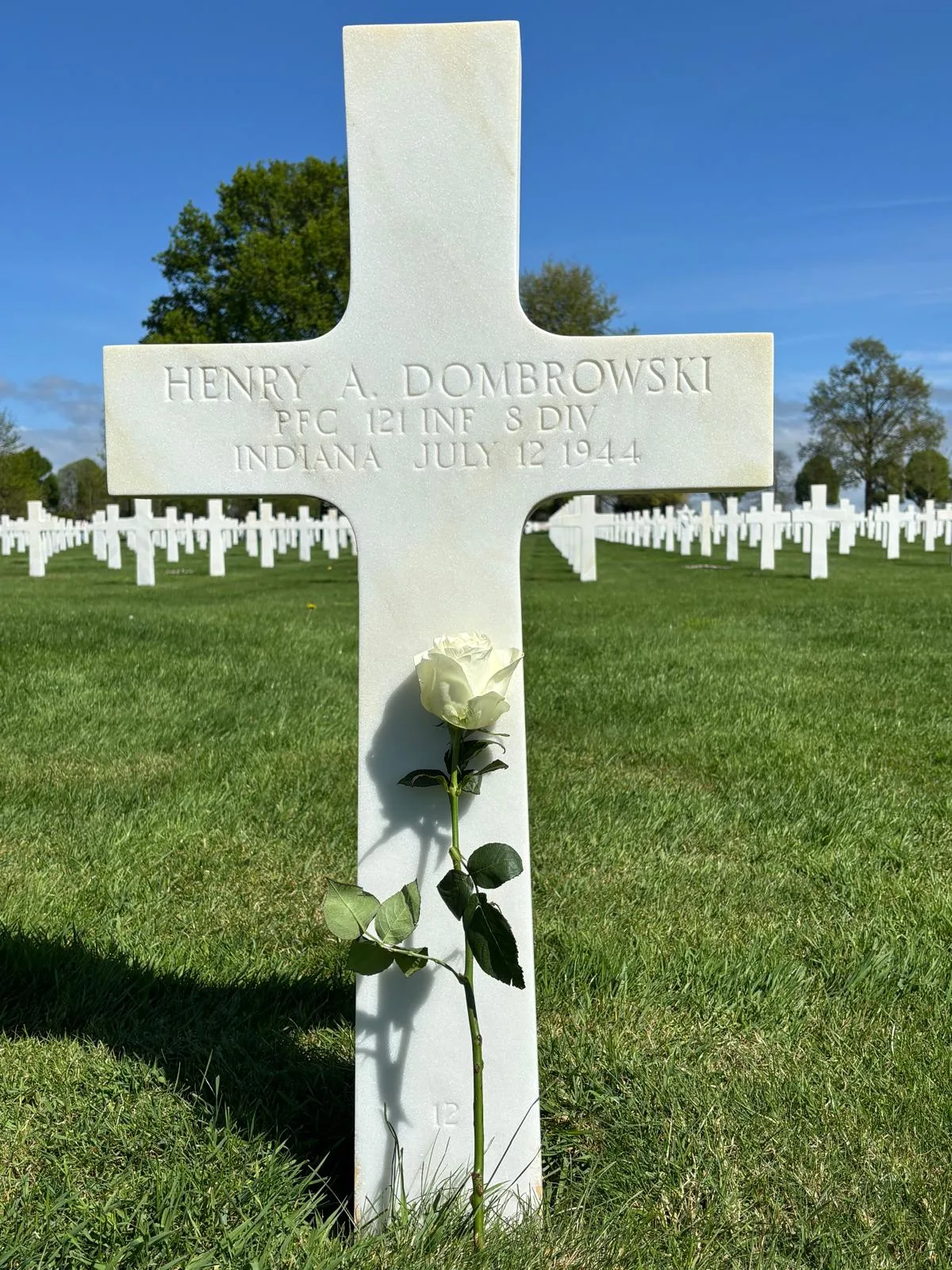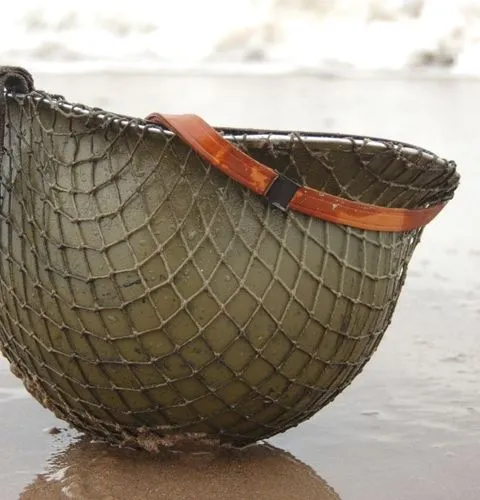
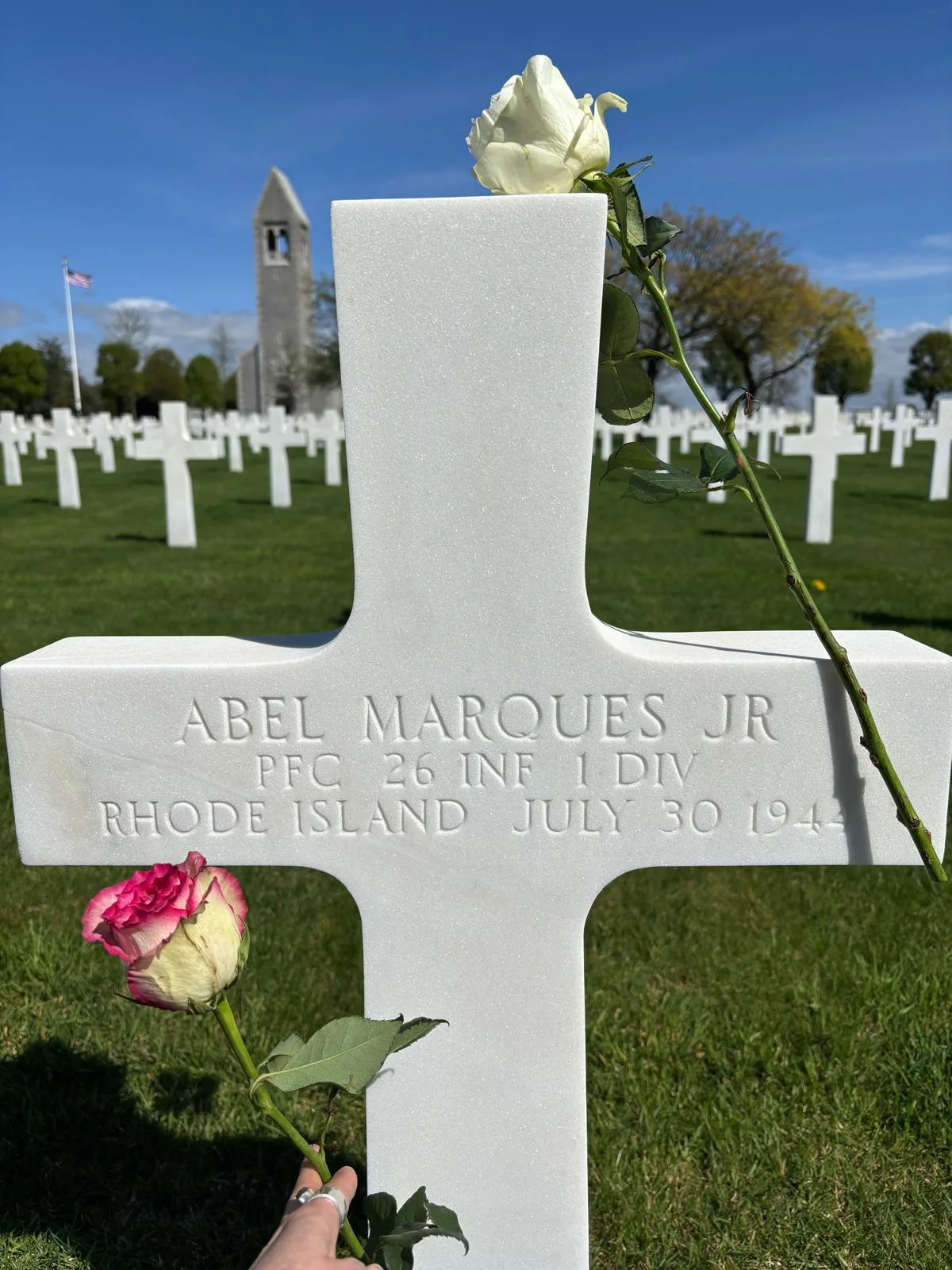
Private First Class Abel Marques Jr was 21 when he fell near Coutances on July 30, 1944. I went to say hello to him at the Brittany American Cemetery, because as a local guide, helping families preserve the memory of their fallen ancestors is part of who I am.
At the Brittany American Cemetery in Saint James, among 4,410 white marble crosses standing in silent rows on a green hillside, one bears the name of a young man from Rhode Island who never came home.
Abel Marques Jr. PFC, 26 INF, 1 DIV. Rhode Island. July 30, 1944.
He was 21 years old.
Why I Came to Say Hello to Abel
I want to start this article with something personal. The roses you see in the photographs below, pink and white, placed gently at the foot of the cross, I laid them myself.
As a licensed driver-guide based in Brittany for 18 years, I have spent countless days walking the beaches of Normandy and the hillsides of Brittany with families from the United States, Canada, the United Kingdom, and beyond. Families searching for a crash site, a grave, a village, a trace of a grandfather or great-uncle who fought and sometimes died here eighty years ago.
Over time, this work has become more than a profession. It has become a calling. And part of that calling, for me, is going to these cemeteries on my own, with no client by my side, to pay my respects. To lay flowers. To say hello, quietly, to the young men who gave their lives so that my country could be free.
Abel Marques Jr is one of them.
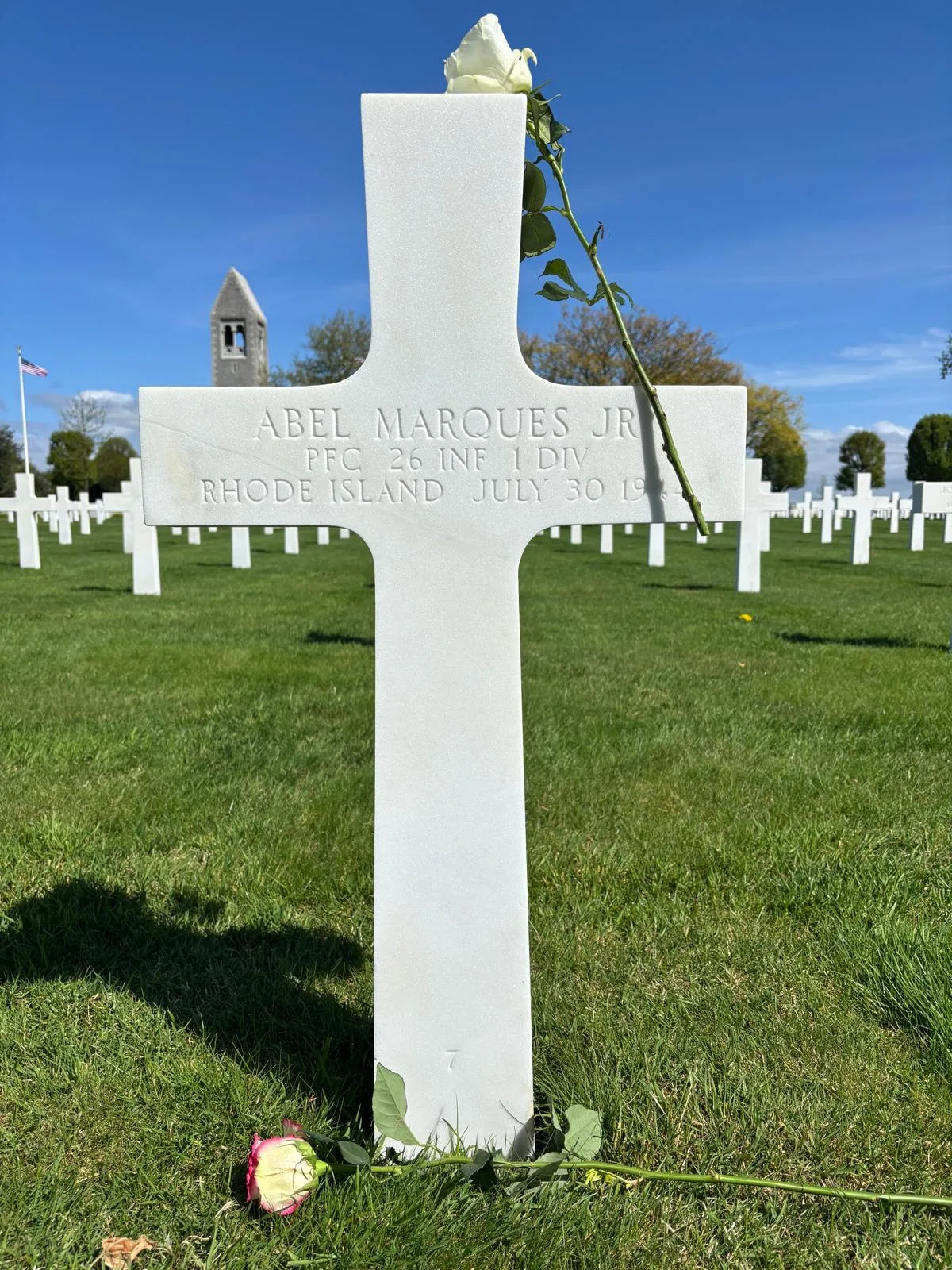 Abel Marques Jr’s grave at the Brittany American Cemetery in Saint James, with the memorial chapel in the background
A Glass Worker from Providence
Abel Marques Jr was born in 1923 in Providence, Rhode Island, to Palmira and Abel Marques Sr, a family of Portuguese descent. Before the war, he worked as a glass worker at the Owens Corning factory. He had two brothers, one of whom served in the US Navy and fought in the Pacific.
On February 1, 1943, at the age of twenty, Abel enlisted in the United States Army. After 17 weeks of basic training at Camp Croft in South Carolina, he was assigned to Company E, 2nd Battalion, 26th Infantry Regiment of the legendary 1st Infantry Division, known as the Big Red One.
From Sicily to Omaha Beach
Abel joined the 26th Infantry Regiment, nicknamed the Blue Spaders, just before Operation Husky. On July 10, 1943, he landed at Gela on the southern coast of Sicily. He took part in the fierce Battle of Troina between July 31 and August 6, where the 26th Regiment played a decisive role in liberating the town after days of heroic resistance against entrenched German forces.
After Sicily, the division returned to Great Britain in October 1943. By then, the Big Red One had become the most battle-tested division in the US Army. In the plan drawn up by SHAEF for the invasion of Normandy, it was given a critical role.
The division underwent intense training and took part in the large-scale amphibious exercises at Slapton Sands in Devon. In late May 1944, the troops gathered before embarking from the port of Portland. On the afternoon of June 5, their ship set course for Normandy.
On June 6, 1944, Abel landed with his regiment at Omaha Beach, on the Fox Green sector, at 7:30 in the evening. By the end of the first week, the division had advanced 23 kilometers and found itself at the tip of the Allied spearhead.
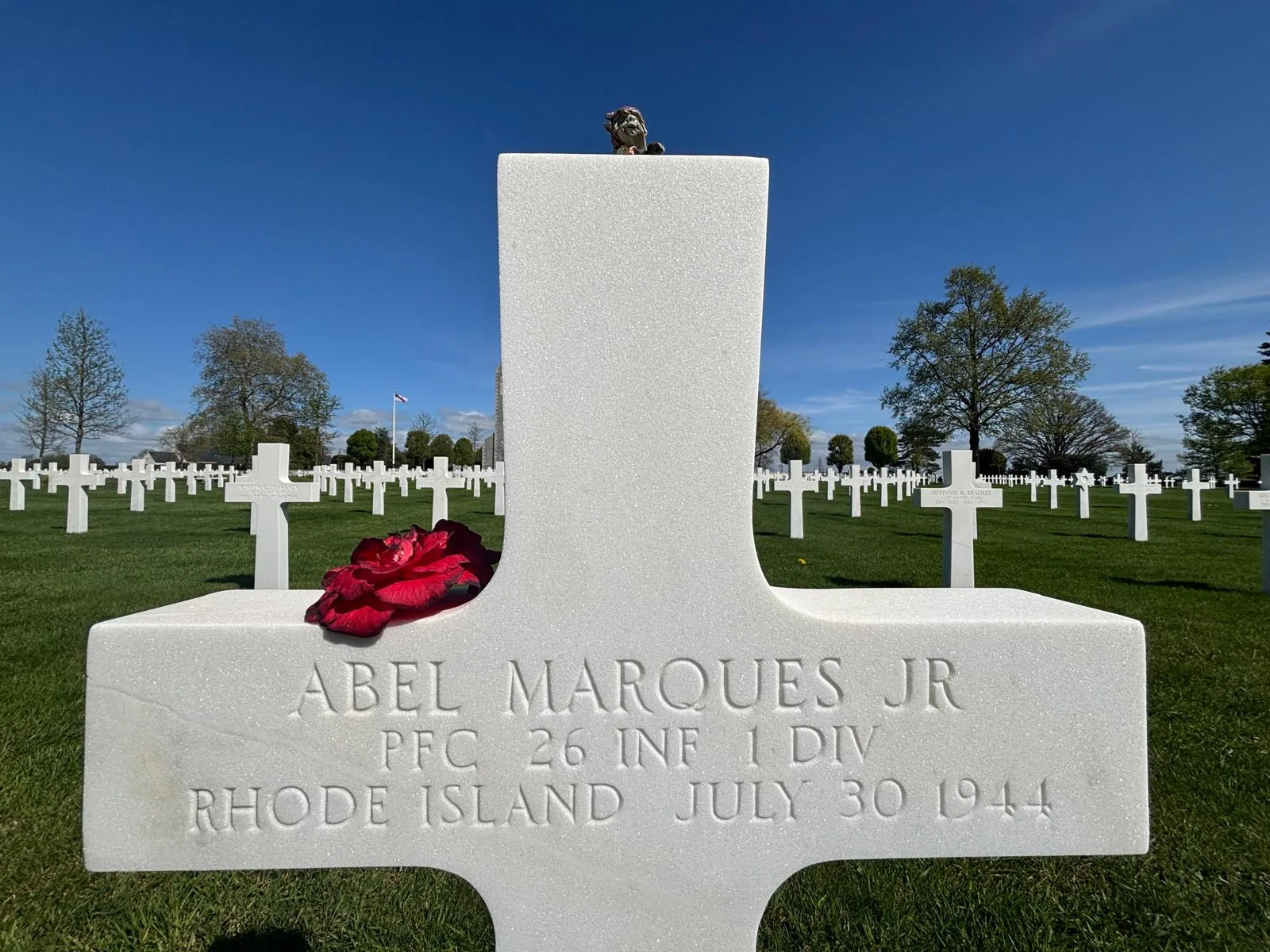 A red rose I placed on Abel’s cross during my visit
The Push Through the Hedgerows
On June 12, the order came to take Caumont-l’Eventé. During the night, the 26th Infantry advanced through the streets and by early morning had secured the town with the support of tanks from the 743rd Tank Battalion.
Until June 30, the men dug foxholes and held their positions. A war of attrition began in the Norman hedgerows.
On July 14, the division was relieved by the 5th Infantry Division and received reinforcements in men and equipment while preparing for Operation Cobra, the massive breakout from Normandy.
July 30, 1944, The Last Day
On July 25, Operation Cobra was launched. After the initial assault units broke through, the 1st Infantry Division pushed toward Marigny and then continued its advance toward Coutances, entering the town on July 28.
On July 30, 1944, German troops encircled by the American advance attempted to break out toward Mortain, supported by Luftwaffe air cover trying to extract them from the trap south of Coutances.
It was during the fighting on that day that Abel Marques Jr was killed in action. He was 21 years old.
His body was initially buried at the temporary American cemetery at Marigny, near Saint-Lo. In 1948, at the request of his family, his remains were transferred to the Brittany American Cemetery in Saint James (Montjoie-Saint-Martin), where he rests today in Plot F, Row 9, Grave 7.
He was awarded the Bronze Star Medal, the Purple Heart, the World War II Victory Medal, and the Combat Infantryman Badge.
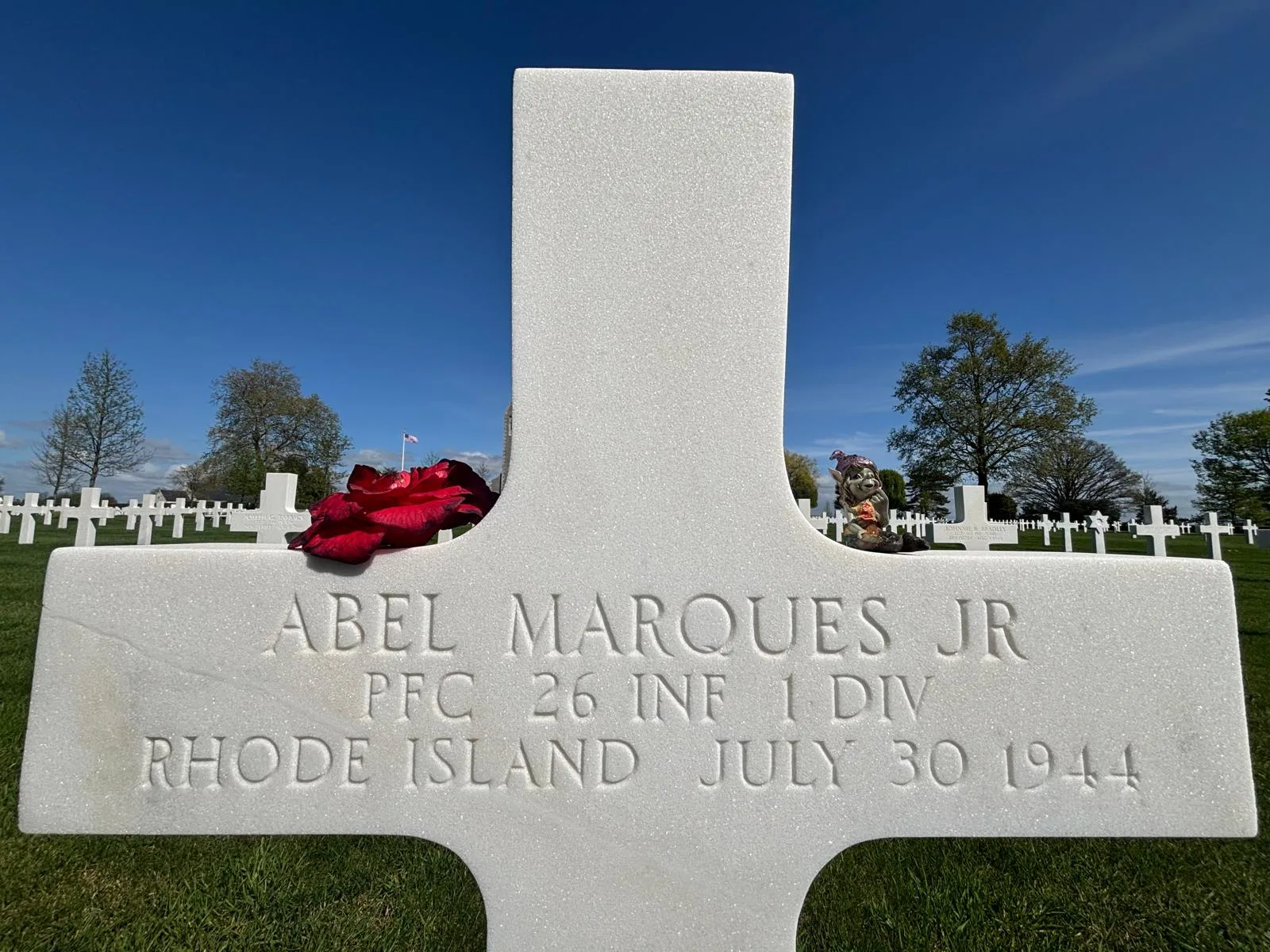 The inscription on Abel’s cross, carved into white marble from the quarries of Lasa, Italy
Laying Flowers at Plot F, Row 9, Grave 7
On a quiet afternoon under a bright blue sky, I drove to Saint James. The Brittany American Cemetery sits on a gentle hillside in the Manche, about twenty kilometers south of Avranches. Once you pass through the iron gates and walk up the main path, the silence is the first thing that strikes you. No traffic, no voices, just the wind moving through the trees and the hushed footsteps of the few visitors.
I walked down Plot F until I reached Row 9, Grave 7. There he was. PFC Abel Marques Jr. 26 INF 1 DIV. Rhode Island. July 30 1944.
I knelt down and placed the roses, one pink, one white, at the base of the cross. A small figurine as well, because every cross here deserves a touch of warmth, a reminder that these men are remembered.
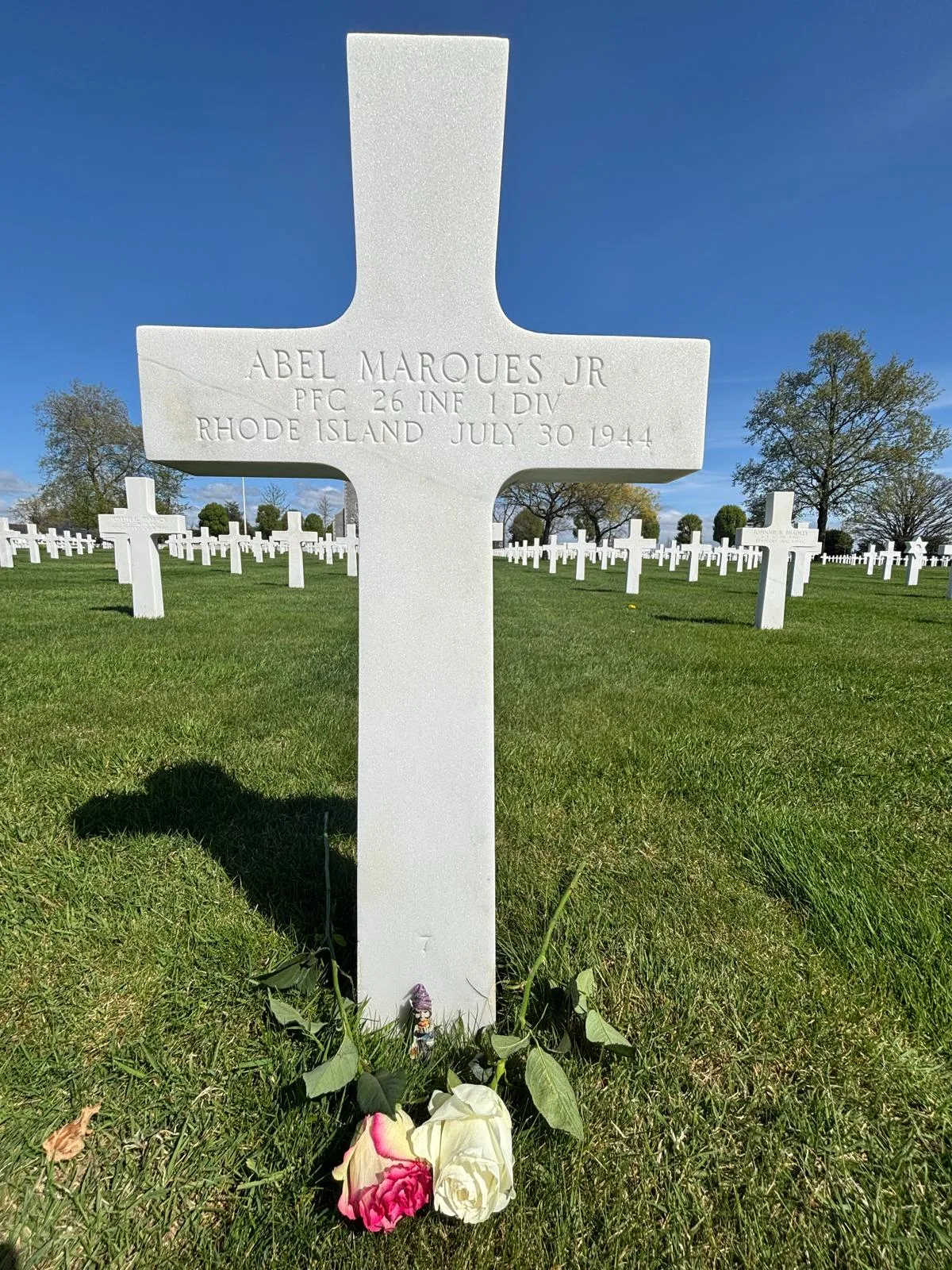 The roses I laid at the foot of Abel’s cross, with a small figurine placed as a personal tribute
I stood there for a long moment. I thought about Palmira and Abel Sr back in Providence, receiving the telegram. I thought about the brother in the Pacific learning the news. I thought about the glass factory that never saw Abel return to his workbench. I thought about the 21 years of a life cut short so that my grandparents, and eventually my parents and myself, could live free.
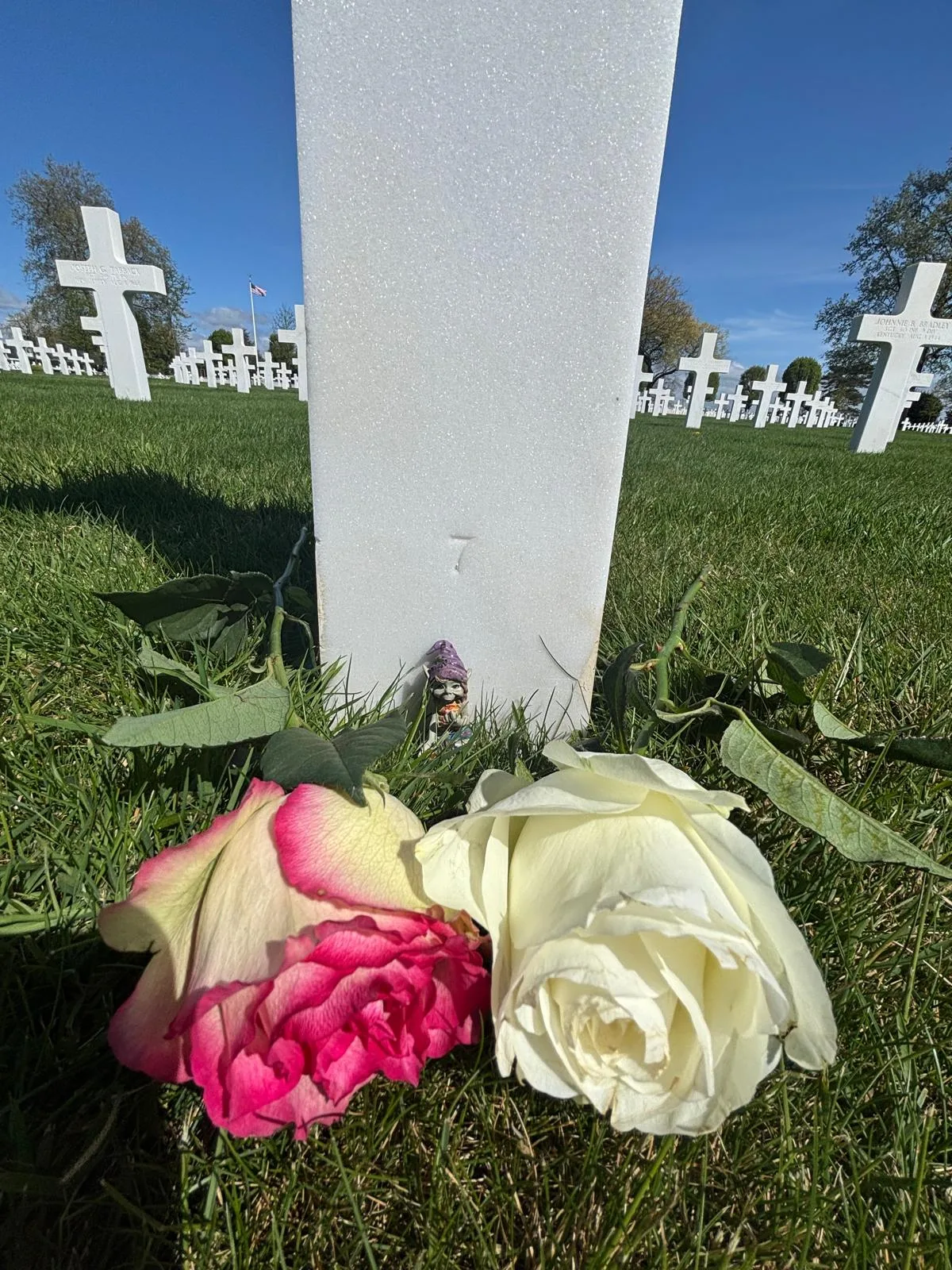 A red rose and a small figurine placed on top of the cross
A Message for John and Abel’s Family
If you are reading this article, John, or anyone connected to the Marques family, I want you to know that Abel is not alone here. The cemetery staff visit his grave every week. Tourists pause in front of his cross. And occasionally, a Breton guide with too much love for her country comes by and leaves him flowers.
This article is also connected to another story I have told on this blog. In September 2024, I had the immense privilege of guiding John Breidenthal to the field in Baulon, Brittany, where his uncle Leslie had parachuted out of a burning B-17 in 1943. You can read that story here.
John’s family, like so many American families, carries the weight of the Second World War across generations. Whether it is Leslie parachuting into a Breton wheatfield, or Abel falling in a hedgerow near Coutances, these stories deserve to be told and retold, for as long as there are people willing to listen.
The Brittany American Cemetery
The Brittany American Cemetery and Memorial is located in Saint James (Montjoie-Saint-Martin), in the department of Manche, about 20 kilometers south of Avranches. It is one of 26 permanent American military cemeteries on foreign soil, administered by the American Battle Monuments Commission.
The cemetery contains the graves of 4,410 American servicemen, most of whom lost their lives during the Normandy campaign and the subsequent advance through Brittany in the summer of 1944. On the Walls of the Missing, 498 additional names are recorded, soldiers whose remains were never recovered.
The site includes a memorial chapel, a reflecting pool, and a tall granite pylon visible across the surrounding countryside. The grounds are immaculately maintained, as they have been every day since the cemetery was established.
Helping Families Keep the Memory Alive
Abel Marques Jr was one of more than 400,000 Americans who died during the Second World War. His story is not in the history books. There is no monument with his name beyond the white cross in Plot F. But he was someone’s son, someone’s brother, someone’s colleague at the glass factory. And eighty years later, he is still someone’s family.
This is why I do this work. At Bellidays, we believe that the most meaningful way to visit the memorial sites of Normandy and Brittany is with context, with care, and with time. These are not checkboxes on a tour itinerary. They are places where real people gave everything, and where their families still come to remember.
If your family has a connection to the Second World War in France, whether through a soldier, a sailor, an airman, or a nurse, contact us. I will help you find their story, walk the ground they walked, and honor their memory in a way that no group tour ever could.
And if one day you cannot travel to France yourself, I will go in your place. I will find the grave. I will lay the flowers. I will take the photographs. And I will come back and tell you that your soldier is not forgotten.
For Abel Marques Jr, PFC, 26th Infantry Regiment, 1st Infantry Division. Providence, Rhode Island. Fallen near Coutances, July 30, 1944. Forever remembered.