Hank and Babe Dombrowski left the steel town of Gary, Indiana and never came home. They fell thirty-eight days apart in the summer of 1944, and today they lie side by side at the Brittany American Cemetery in Saint-James. This September, their family is crossing the ocean to visit them, and I went ahead to say hello.
At the Brittany American Cemetery in Saint-James, among 4,410 white marble crosses standing in silent rows on a green hillside, two of them sit right next to each other. They carry the same last name.
Henry A. Dombrowski. PFC, 121 INF, 8 DIV. Indiana. July 12, 1944.
Peter T. Dombrowski. PFC, 359 INF, 90 DIV. Indiana. August 19, 1944.
Two brothers from the same Polish immigrant family, from the same steel town in Indiana, who fell thirty-eight days apart in the summer of 1944 and never made it home. Today they lie side by side, and this September their family is crossing the ocean to stand in front of them.
Two Brothers, Two Roses
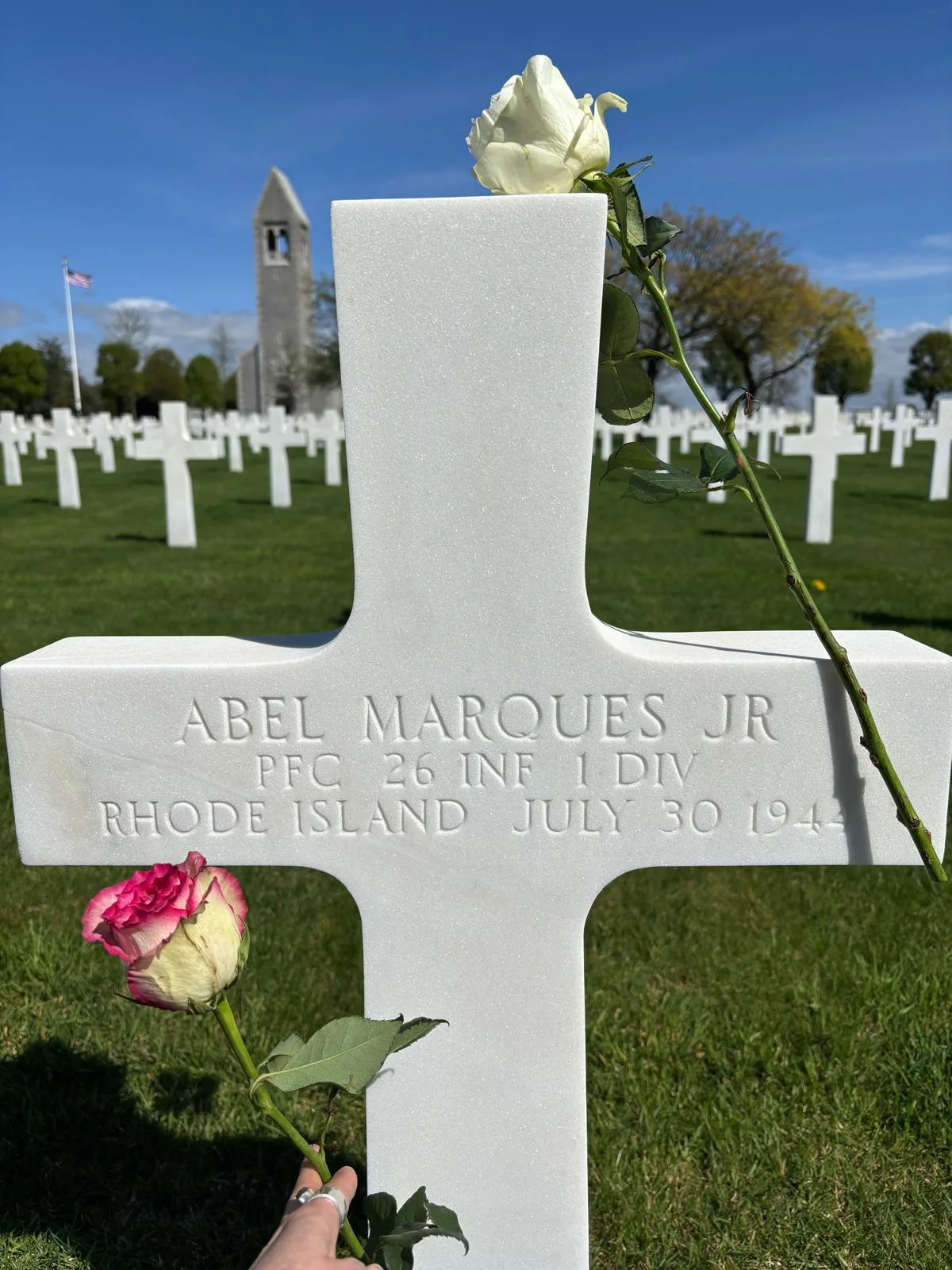
I want to start with something personal. The roses you see in these photographs, one white and one pink, placed gently at the foot of each cross, I laid them there myself.
As a licensed driver-guide based in Brittany for eighteen years, I have spent countless days walking the beaches of Normandy and the hillsides of Brittany with families from the United States, Canada, the United Kingdom and beyond. Families searching for a crash site, a grave, a village, a trace of a grandfather or a great-uncle who fought and sometimes died here eighty years ago.
Over time, this work has become more than a profession. It has become a calling. Part of that calling, for me, is going to these cemeteries on my own, with no client beside me, to pay my respects. To lay flowers. To say hello, quietly, to the young men who gave their lives so that my country could be free.
This time, I went for a reason that touched me deeply. A member of the Dombrowski family is coming to Brittany in September to visit her two uncles, Hank and Babe. Before she arrives, I wanted to go ahead and greet them on her behalf, so that when she walks up to those two crosses, she will know that someone here was already thinking of them.
From the Steel Town of Gary, Indiana
The Dombrowskis were a Polish family. The father, Ferdinand, known as Fred, was born in 1875 in a small village in northeastern Poland. As a young man he was conscripted into the Russian army, where he served as a cook. In 1903 he emigrated to America, arriving first in the coal-mining country of Pennsylvania, where he met his wife, Mary Ann Grabowska, also from Poland. They married in 1910.
Unimpressed with life in a coal town, Fred and Mary headed west and settled in Gary, Indiana, the planned community built by U.S. Steel. Fred took a job at the mill, and the family moved into a two-story brick home on the working-class East Side, the part of town where the streets were named after states, not presidents. Over the years they added eight more children to the family, ten in all.
Henry, known to everyone as Hank, was the sixth child. His younger brother Peter, known as Babe, was the seventh. They grew up in a tough, hard-working immigrant neighborhood, the kind of place where a middleweight boxing champion named Tony Zale, a family friend, was the local hero. And like millions of other young men of their generation, both brothers put on the uniform when the war came.
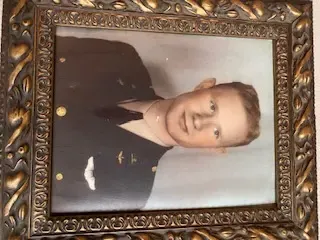
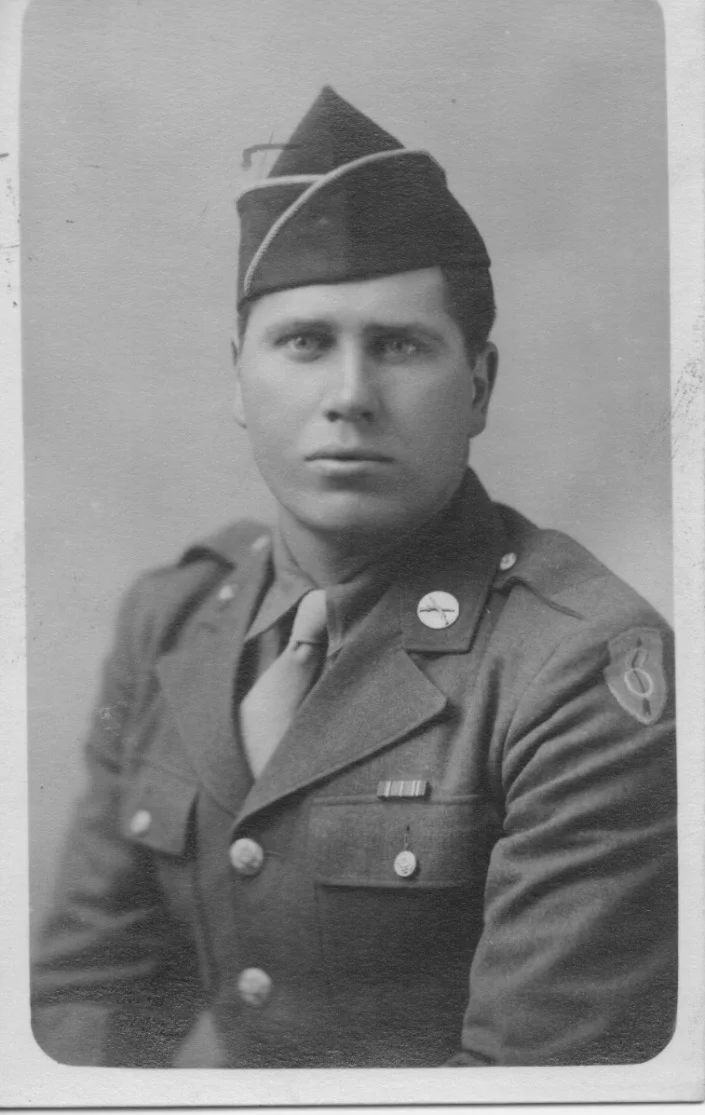 Hank Dombrowski, PFC in the 121st Infantry Regiment, 8th Infantry Division
The army split them between two divisions, as it often did with brothers, to spare families the risk of losing everything in a single blow. Hank went to the 121st Infantry Regiment of the 8th Infantry Division, the Golden Arrow. Babe went to the 359th Infantry Regiment of the 90th Infantry Division. It did not work.
Hank, Five Days in the Hedgerows
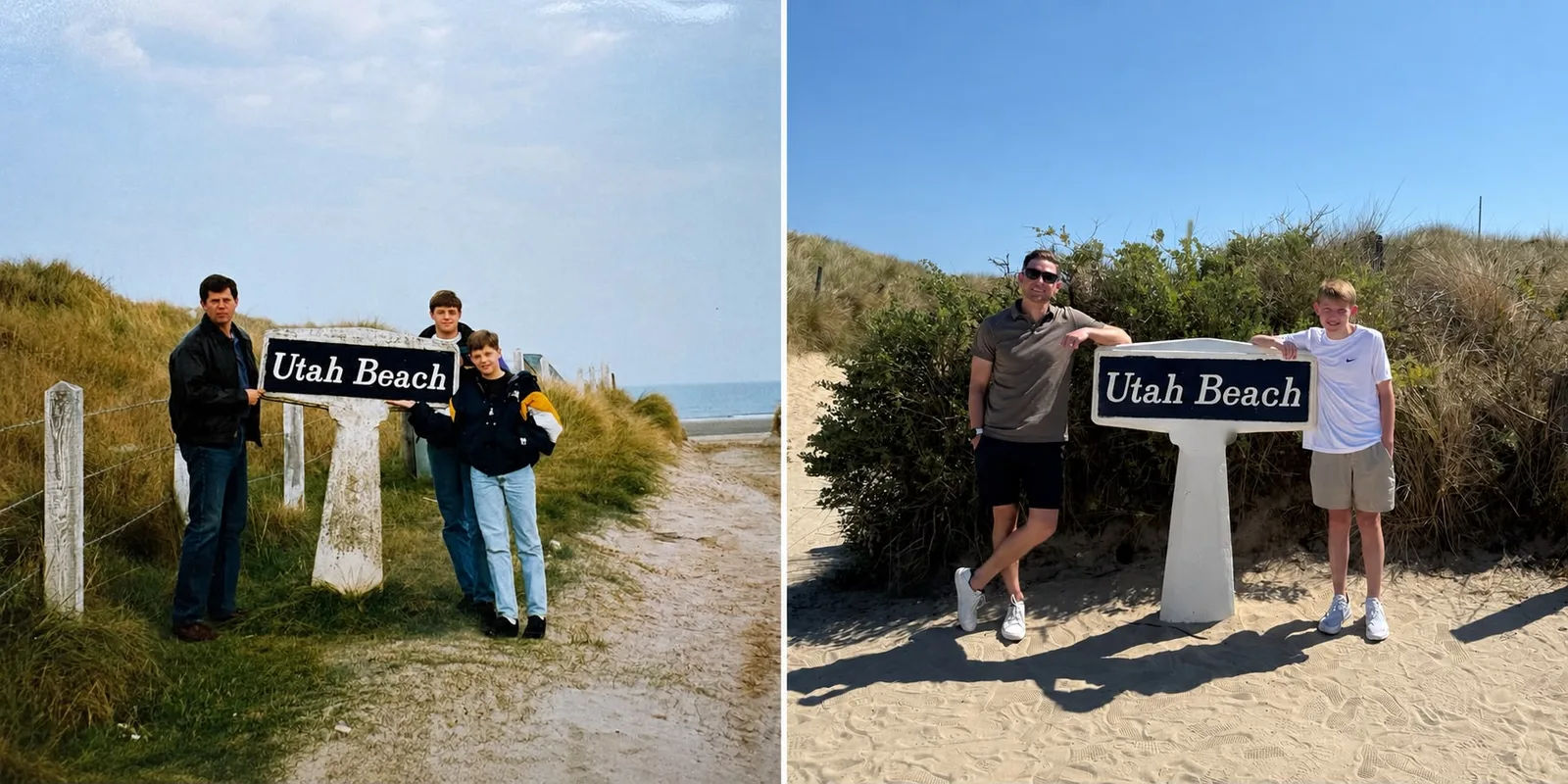
Hank’s regiment came ashore at Utah Beach in early July 1944 and pushed inland through the record summer heat, into the fighting for the Cotentin. Within days the men were caught in the bocage, the ancient network of hedgerows that turned every Norman field into a small fortress and every sunken lane into a potential ambush.
Hank lasted just five days in combat. He was killed on July 12, 1944, in the sector of La Haye-du-Puits. He was one of twenty-six men from his regiment to fall in those first brutal days, in a landscape most Americans had never heard of, in a battle overshadowed by the drama of the landings themselves.
Back home in Indiana, the family received the telegram. But the war does not stop for grief, and somewhere in France, Hank’s younger brother was still fighting, still writing home, still holding on to the hope that the two of them would come through it together.
A Photograph That Stopped a French Woman in Her Tracks
Here is where the story takes a turn that still gives me chills.
Séverine Le François lives in Coutances, in Normandy. For years she has been a member of Les Fleurs de la Mémoire, a French association whose members each adopt the grave of an American soldier buried in Normandy or Brittany and commit to visiting it, tending it and laying flowers there, year after year, for a young man they never knew. Hank and Babe are her soldiers. She has been watching over their two crosses at Saint-James for years.
That is how she and the Dombrowskis found each other. During the seventy-fifth anniversary commemorations of the Second World War, Séverine reached out to the family in the United States to learn about the two brothers whose graves she was caring for. They have stayed connected ever since, seven years of messages across the Atlantic between a French woman in the Manche and an American family with roots in Gary, Indiana. This September, for the first time, they will finally meet in person, and that is priceless.
Then, in the spring of 2026, Séverine was leafing through one of the annual books that the regional newspaper Ouest-France publishes on the liberation of her department. She came across a photograph dated July 5, 1944, taken in the sector of La Haye-du-Puits: an American soldier in full combat gear, rifle in hand, standing in front of a Norman brick farmhouse.
Something about the soldier’s face made her stop. She thought at once of Henry Dombrowski, her Hank. She wrote to the family.
The 121st Infantry was fighting in that very sector in those very days. If the man in the photograph is Hank, it would be an image of him alive, only a week before he was killed. The identification has not been confirmed, and it may never be. But the date, the place and the unit all line up. Somewhere in a newspaper archive in the Manche, there may be a last glimpse of a young man from Gary, Indiana, caught by a camera seven days before the hedgerows took him.
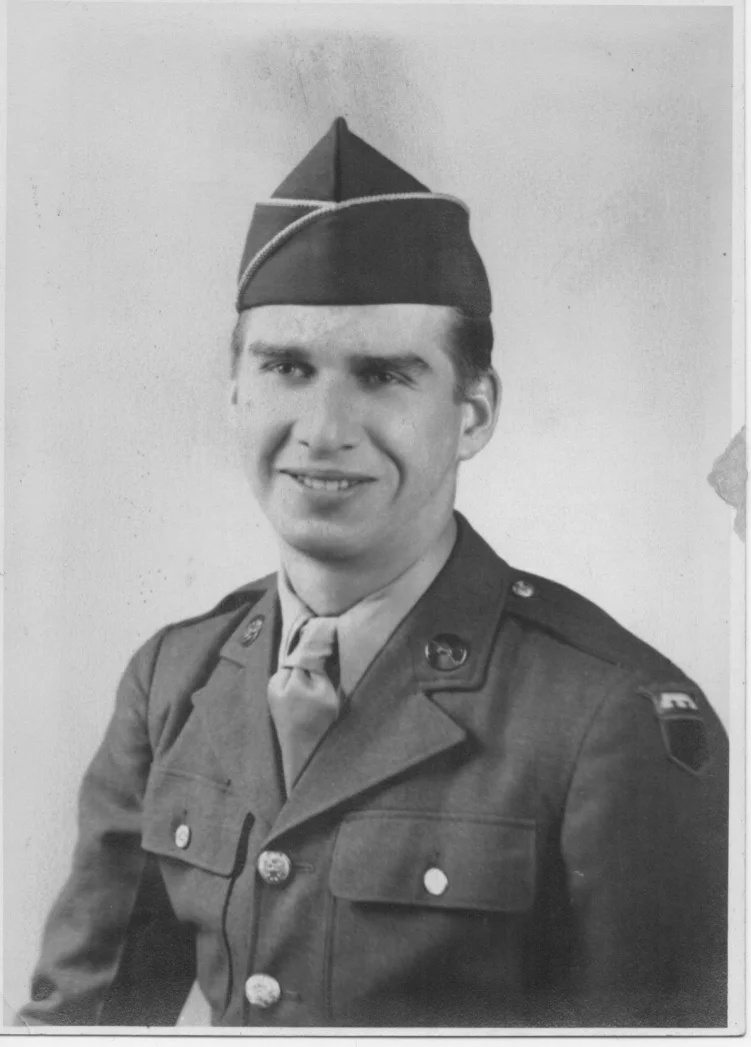 Babe Dombrowski, PFC in the 359th Infantry Regiment, 90th Infantry Division
Babe, and the Letter That Breaks Your Heart
Peter served in the 359th Infantry Regiment of the 90th Infantry Division, which had begun landing at Utah Beach in the first days of the invasion. He fought through the bocage, through the bloody slopes of the Forêt de Mont Castre, and on through the Avranches breakout that finally cracked the German line open.
Three weeks after Hank was killed, Babe, who did not yet know his brother was gone, wrote a letter to their older brother Chester, who was stationed in England. The words he wrote that day are almost impossible to read without feeling the weight of what was coming.
You can bet your life I’ll follow your advice and with the good grace of God, Hank and I will pull through this. I’m looking forward to the reunion and to one helluva time. You know I missed Hank by about 2 minutes or 500 yards, which makes it twice. The third time should be a charm and I’ll hope we’ll meet.
He was writing about a reunion with a brother who was already buried in the ground of Normandy. He was hoping that the third time would be the charm, that they would finally cross paths somewhere in France and share one good evening together.
Babe was killed on August 19, 1944, while taking out a German machine gun nest during the fighting on the Brittany peninsula. For his actions that day he was awarded the Bronze Star. He died not knowing that Hank had gone ahead of him, thirty-eight days before. He died believing in the reunion that would never happen.
Reunited at Last, Side by Side at Saint-James
The Dombrowski brothers did meet again, in the end. They meet every single day now, here at the Brittany American Cemetery in Saint-James, where they are buried side by side.
There is something almost unbearable about that, and something quietly beautiful too. Two brothers who spent the last months of their lives missing each other across the roads and fields of France, sometimes by only two minutes or five hundred yards, now rest a few inches apart on a peaceful green hillside, their two crosses catching the same morning light.
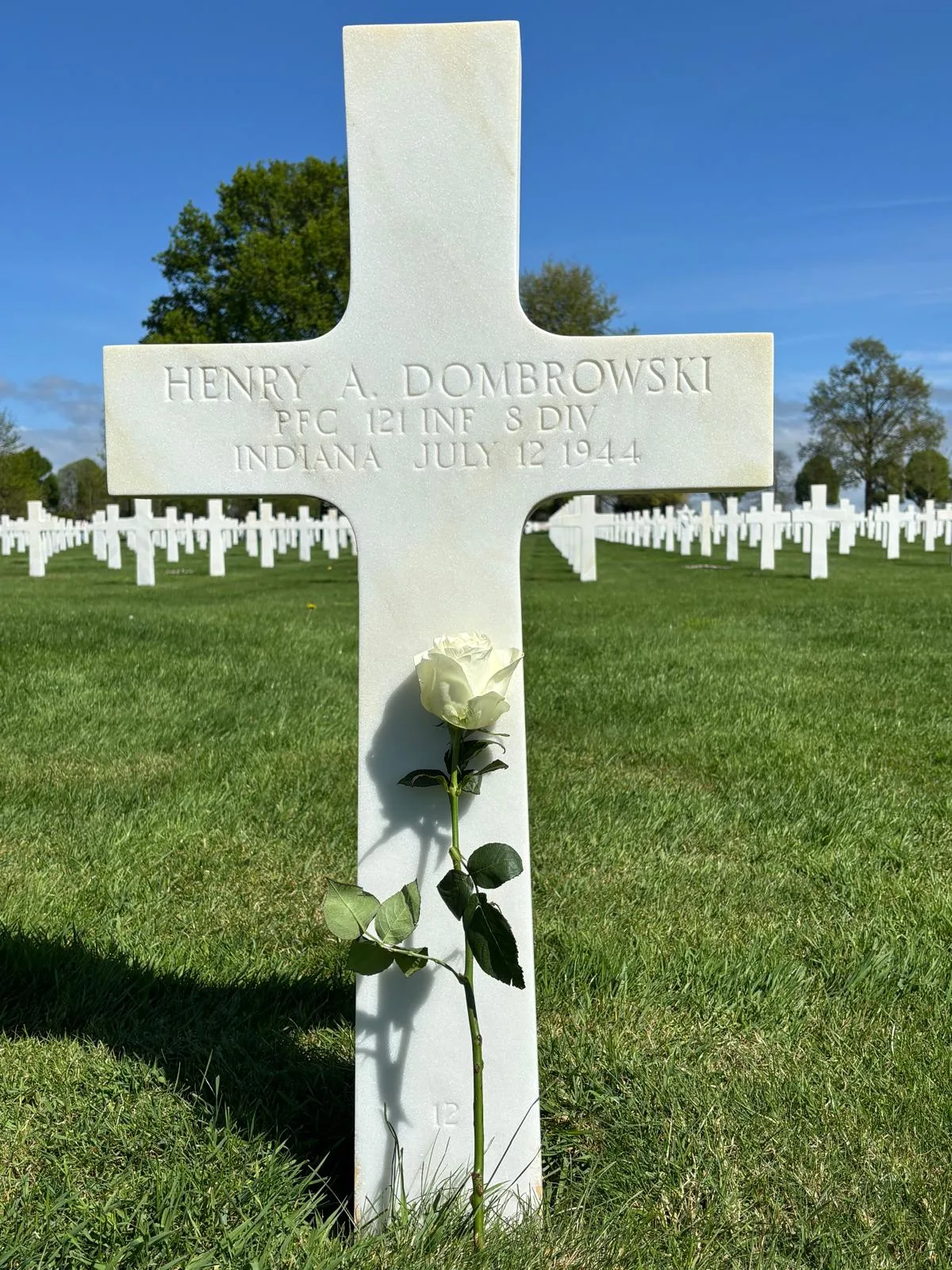 Hank’s cross, with a white rose I laid at its base when I went ahead to greet the brothers
The cemetery sits just inside Normandy, in the department of Manche, near the border with Brittany. France granted the use of this land, in perpetuity and free of charge, to the United States as an act of recognition. It holds 4,410 American servicemen, most of whom fell during the liberation of Brittany and the fierce fighting of that summer.
Unlike the segregated steel town they grew up in, where the street you lived on told the world your rank and your race, their final resting place makes no distinctions at all. American war cemeteries are not organized by rank, race, religion or class. Here, a private from a Polish immigrant family on the East Side of Gary lies among all the others, equal under the same white marble.
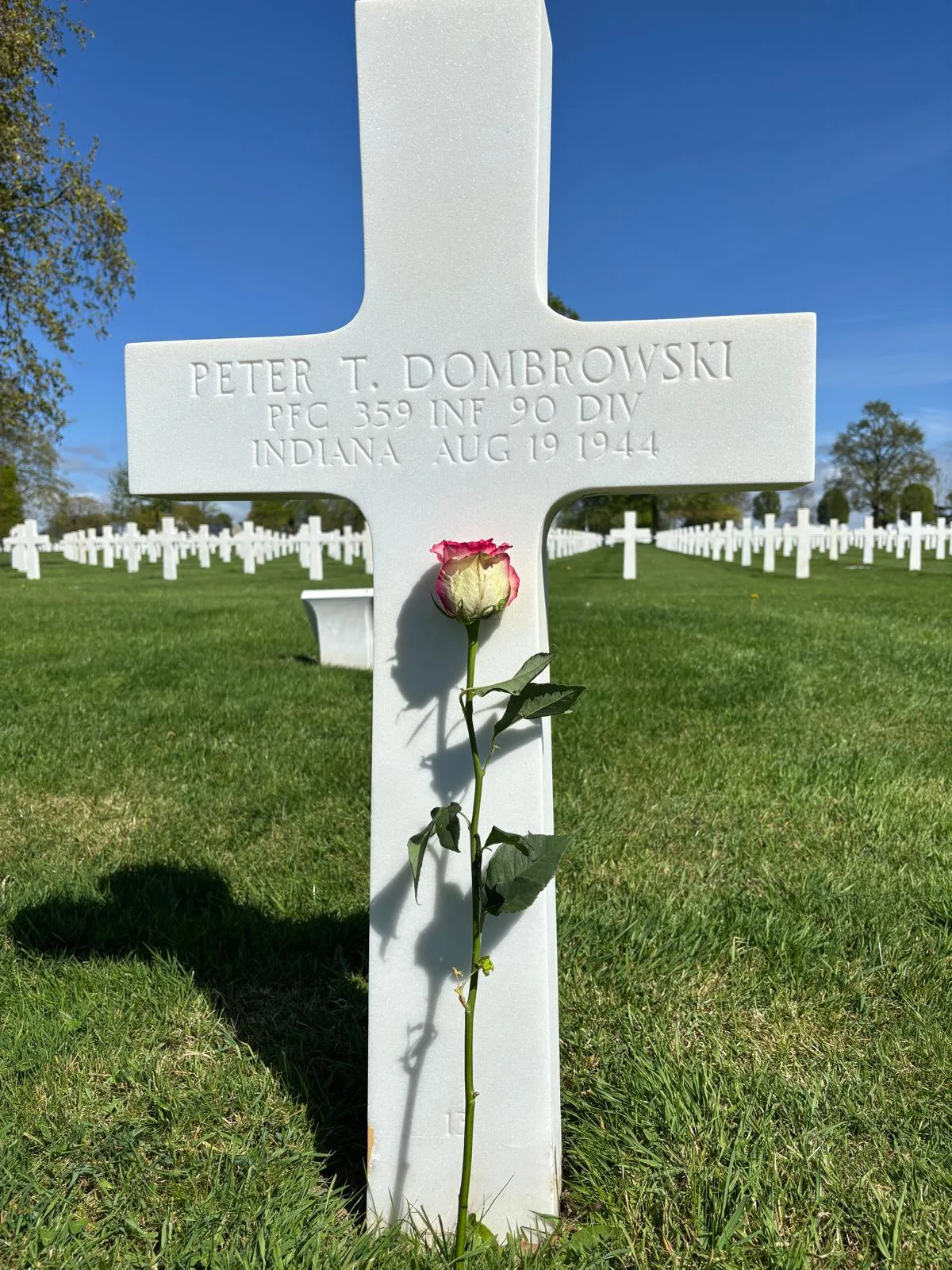 Babe’s cross, a few steps from his brother’s, with a rose I placed beside him
The Book That Found Them
Their story did not stay within the family. The author Kevin M. Callahan spent years researching every pair of brothers buried side by side in American World War II cemeteries overseas, conducting hundreds of family interviews and making personal pilgrimages to all fourteen overseas cemeteries maintained by the American Battle Monuments Commission. The result is “Brothers in Arms: Remembering Brothers Buried Side by Side in American World War II Cemeteries”, published in 2020 and winner of the Bill Fisher Award for Best First Book in nonfiction.
Callahan found the two crosses at Saint-James bearing the name Dombrowski, traced the family, and told their story, with photographs. When their niece first held that book, she wondered whether the story had been inspired by her uncles. The answer turned out to be the other way around entirely. Callahan found Hank and Babe, researched their lives, and made sure the world would know their names. The book is not inspired by them. It is about them.
This September, the Family Is Coming
This September, the family is coming. A niece and her son will cross the Atlantic to stand in front of those two crosses, to touch the marble that bears those names, to lay flowers where no flowers were laid in the summer of 1944. It is a journey decades in the making, and I will have the profound honor of accompanying them.
I want to say this simply and directly. Accompanying the descendants of our liberators on the traces of the men who gave their lives so that I could be free is not a professional engagement for me. It is a privilege I do not take lightly. These men came from the other side of the world, from a steel town in Indiana, speaking Polish at home and American everywhere else, and they died in a country they had never seen for a cause that was not theirs by birth, only by conviction. Every time I stand in one of these cemeteries, I feel the weight of that gift.
If You Are a Descendant Thinking of Making the Journey
If you are the descendant of an American soldier who fell in Brittany or Normandy, and you are thinking about making this journey, know that you will not be alone. Both regions are home to many active commemorative associations whose members are devoted to honoring the memory of these soldiers and to supporting research into their stories. They have access to local archives, military records, battlefield maps and a living memory still being passed down through families who remember 1944 as though it were yesterday. Do not hesitate to reach out to them. They will welcome you with the warmth and gratitude that the people of this region have never stopped feeling toward America’s fallen.
Les Fleurs de la Mémoire, the association Séverine belongs to, is one of them. Its volunteers adopt the grave of an American soldier and become, in a very real sense, his French family: they come to the cemetery, they bring flowers, they remember his name on the days that matter. As Séverine put it to me one day, it is thanks to this association that so many of these godparents have come forward to honor the memory of all these soldiers, and it is thanks to it that a woman in Coutances and a family in Indiana found each other across eighty years and an ocean. If your soldier rests in one of these cemeteries, there is a real chance that someone here has already been laying flowers on his grave for years.
Come in September. The light is golden over the bocage then, and the fields are quiet. You can drive through the lanes where Hank’s regiment fought its way through the hedgerows, past the granite farmhouses, past the rivers where Babe’s division crossed under fire. It all looks peaceful now. That peace had a price, and two brothers from Gary, Indiana are part of that price.
If your own family has a connection to the Second World War in France, whether through a soldier, a sailor, an airman or a nurse, contact us. I will help you find their story, walk the ground they walked, and honor their memory in a way that no group tour ever could. And if one day you cannot travel to France yourself, I will go in your place. I will find the grave. I will lay the flowers. I will take the photographs. And I will come back and tell you that your soldier is not forgotten.
À Hank. À Babe. Et à la famille qui traverse l’océan pour les retrouver enfin.
Belinda C.
Sources: Kevin M. Callahan, “Brothers in Arms” (2020); After Action Reports, 8th and 90th Infantry Divisions; American Battle Monuments Commission; Ouest-France, Manche, 2026. With thanks to Séverine Le François, of Coutances, Normandy, member of Les Fleurs de la Mémoire, who has cared for the brothers’ graves for years and who found the photograph.