A licensed Breton guide explains fleur de sel de Guérande: how the paludiers harvest it by hand, what makes it genuinely different from table salt, its real health benefits, and how to visit the salt marshes of historic Brittany.
Let me settle an argument before we begin.
Yes, Guérande sits in Loire-Atlantique, which since a 1941 administrative reshuffle belongs to the Pays de la Loire region. And no, that does not make it any less Breton. Guérande was part of the Duchy of Brittany for a thousand years, its salt paid Breton taxes, its paludiers spoke of themselves as Bretons, and every single Breton I know will tell you the same thing with a certain firmness in the voice. Administrative borders are drawn in offices. History is drawn in the land. In Guérande, the land is made of salt.
After nearly two decades driving travelers through this region, I have taken hundreds of guests into those marshes at the end of a summer afternoon, when the light goes low and the water turns pink and the whole basin looks like a mirror that someone forgot to put away. Almost every one of them ends the visit holding a small linen sack of fleur de sel and asking the same question: what actually makes this salt different?
Here is the honest answer.
What Fleur de Sel Actually Is
Fleur de sel is not a brand, a grade, or a marketing word. It is a specific thing that happens on the surface of a salt pond on a specific kind of day.
The Guérande marshes cover around two thousand hectares of clay basins fed by the Atlantic through a network of channels. Seawater enters on the high tide and then travels slowly, over days, through a series of shallow ponds that grow progressively saltier as the sun and the wind take the water away. The final basin, the one where crystallization actually happens, is called an oeillet. It is barely a few centimeters deep and about seventy square meters in size, and each one has a name and a history, often passed down through the same family for generations.
When conditions are right, meaning strong sun, low humidity, and a dry wind from the northeast, a thin veil of fine crystals forms on the very surface of the water in the oeillet. That veil is the fleur de sel. It floats. It never touches the clay bottom, which is why it stays white rather than taking on the grey tint of the coarse salt harvested underneath.
The paludier skims it off by hand, at the end of the day, with a long-handled wooden tool called a lousse à fleur. It is a slow, delicate gesture, and it has to be done before the wind drops or the humidity rises, because a single bad evening sends the whole veil sinking to the bottom where it becomes ordinary coarse salt. A good oeillet yields around a kilo and a half of fleur de sel on a good day. On a bad day, nothing at all.
That is the entire production process. No mining, no refining, no chemistry, no heat, no additives. Sun, wind, clay, seawater, and a person with a wooden rake.
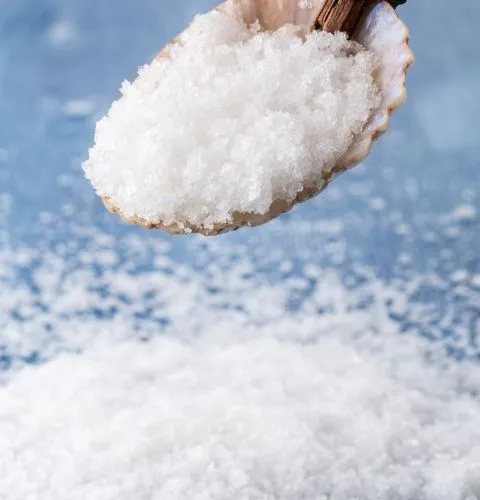 Fleur de sel crystals, damp, irregular, and nothing at all like the powder in a supermarket shaker
Fleur de Sel and Gros Sel: Two Salts, One Marsh
Visitors often assume the marshes produce one product. They produce two, and they are not interchangeable.
Gros sel gris, the coarse grey salt, crystallizes at the bottom of the oeillet and is raked toward the edge with a tool called a las. It picks up minerals and a little clay from the basin floor, which gives it that unmistakable grey colour and a slightly damp texture. This is the workhorse: pasta water, roasting salt, salt crusts for a whole sea bass, the salt in your bread dough. It is also the salt that has been salting Breton butter for eight centuries.
Fleur de sel is the finishing salt. It is fragile, crunchy, faintly humid, and it should never see the inside of a cooking pot. You put it on food at the last possible moment, after the heat, so the crystals stay whole and dissolve on the tongue rather than in the pan. Using fleur de sel to salt your boiling water is the culinary equivalent of using a vintage Bordeaux to deglaze a frying pan. Technically possible. Please do not.
There is also a detail almost nobody notices: good fleur de sel smells faintly of violets. That is not poetry, it comes from a microalgae called Dunaliella salina that thrives in hypersaline water and produces the compound responsible. Open a fresh sack in a quiet room and you will catch it.
The Real Benefits of Fleur de Sel
I want to be straight with you here, because there is a great deal of wellness nonsense written about sea salt and I would rather you trusted me on the parts that are true.
Fleur de sel is still salt. It is still predominantly sodium chloride, and if your doctor has told you to reduce your sodium intake, switching to an artisanal French salt does not change that conversation. Anyone who tells you otherwise is selling something.
That said, the differences between fleur de sel de Guérande and industrial table salt are real, measurable, and worth understanding.
It Is Unrefined and Contains Nothing Else
Standard table salt is typically refined to around 99.9 percent sodium chloride, then treated with anti-caking agents so it pours freely. Fleur de sel de Guérande is not washed, not refined, not bleached, and contains no additives whatsoever. What comes out of the marsh is what goes into the sack.
It Retains Its Marine Trace Minerals
Because it is never washed or refined, fleur de sel keeps the trace elements naturally present in Atlantic seawater: magnesium, calcium, potassium, and a range of trace minerals in small quantities. These are present in modest amounts, so nobody should treat their salt cellar as a mineral supplement, but they are what give the salt its complexity and its slightly less aggressive, less flatly saline taste.
It Naturally Contains Less Sodium by Weight
The residual moisture and mineral content mean fleur de sel is typically somewhat lower in sodium chloride per gram than refined table salt. The difference is not dramatic, but it is real, and it works in your favour.
You Genuinely Use Less of It
This is the benefit that matters most in practice, and it is the one I have watched play out at my own table. Because the crystals are large and crunchy and dissolve directly on the tongue, the salt hits your palate in bright, distinct bursts rather than as a uniform background. Your brain registers the seasoning far more clearly. Most people who switch to finishing with fleur de sel end up using noticeably less salt overall, because a small pinch does more work.
Cook with restraint, finish with fleur de sel, and you will eat better food with less sodium than before. That is the honest health argument, and it is a good one.
It Carries Natural Iodine, but Not Much
Sea salt contains iodine naturally, but in far smaller quantities than industrially iodized table salt. If iodized salt is part of your medical routine, keep it for daily cooking and use fleur de sel as your finishing salt. The two coexist perfectly well in the same kitchen.
Salt, Taxes, and Breton Stubbornness
You cannot understand Breton food without understanding the gabelle.
From the fourteenth century onward, the kingdom of France taxed salt savagely. In most provinces, salt was so expensive that peasants rationed it. Brittany, thanks to the privileges it retained when it joined the French crown, was exempt. Salt from Guérande cost almost nothing on Breton soil and a small fortune fifty kilometers inland.
Two things followed. First, an enormous smuggling economy, the faux-saunage, with salt carried across the border by night in a trade so profitable that entire villages lived off it and the penalties for getting caught ran to the galleys. Second, and far more delicious, the Bretons started salting everything. Butter above all, which is why Brittany eats salted butter to this day while the rest of France eats sweet cream butter, a story I tell in full in my guide to Breton baratte butter and Jean-Yves Bordier.
Caramel au beurre salé, salted butter kouign-amann, salt-crusted fish, salted butter on a hot galette: every one of those Breton signatures exists because a duchess negotiated a tax exemption and a few thousand paludiers kept raking.
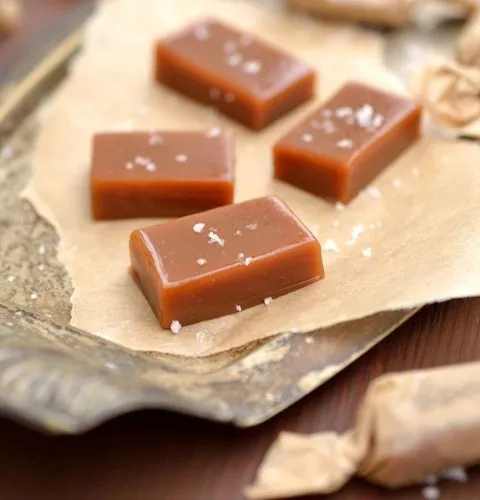 Caramel au beurre salé, finished with a few crystals of fleur de sel, the most Breton dessert there is
How to Recognise the Real Thing
The Guérande marshes are protected, but the word “sea salt” is not. Here is what I tell my clients to look for.
Sel de Guérande carries a protected IGP (Indication Géographique Protégée) at European level, and the fleur de sel additionally carries a Label Rouge certification, France’s quality mark. The packaging of genuine product will name Guérande explicitly, and usually names the producer group or the individual paludier as well.
Be careful with the phrase “fleur de sel de l’Atlantique” or “sea salt harvested in France”, which are legal but tell you nothing about origin or method. And be suspicious of anything strikingly cheap. Fleur de sel is harvested by hand a kilo at a time, in a season that runs roughly from June to September and vanishes entirely in a wet summer. It cannot be cheap.
The best purchase is still the simplest: buy it in Guérande, from a cooperative shop or directly from a paludier, and pay two or three euros more than you would at home for something several grades better. It is also, at a few hundred grams, one of the most compact and least breakable souvenirs you can carry back in a suitcase.
How to Use It Properly
Three rules, and then you are on your own.
Always add it after cooking, never during. Heat destroys the texture that you paid for.
Add it with your fingers, not a grinder or a shaker. Fleur de sel is meant to be pinched. Grinding it turns it back into ordinary salt and wastes the entire point.
Use it where the crunch will be noticed. On a grilled piece of fish or a seared scallop. On a ripe tomato with olive oil. On roasted vegetables straight from the oven. On steak, sliced and resting. On a slice of fresh bread with a thick layer of Breton butter. On dark chocolate, on caramel, on a warm brioche. On sliced strawberries, which sounds mad until you try it. And on a fried egg, where it may be at its very best.
Store it in a ceramic or wooden pot with a lid, never in the fridge, and let it keep the small amount of moisture it came with. That dampness is a feature, not a defect.
Visiting the Salt Marshes of Guérande
This is the part I enjoy most, because the marshes are one of those rare places that are both a working landscape and a genuinely beautiful one.
The medieval town of Guérande itself is remarkable and often underestimated: a fully intact fourteenth-century wall, ten towers, four gates, and a compact old town that takes an hour to walk and considerably longer if you stop for a galette. From there the marshes open out to the south and west, a geometric mosaic of clay basins stretching to the horizon, with the salt mounds standing white against the water.
The best time to visit is late afternoon in summer, between June and September, when the harvest is active and the light is at its lowest and warmest. If you can, go on a dry day with a northeast wind, because that is when the fleur de sel actually forms and when you have a real chance of watching a paludier work.
I generally build the visit into a wider day, because Guérande sits beside two other places I love. Just north lies the Parc Naturel Régional de Brière, the great Breton marshland of thatched cottages and flat-bottomed boats, and inside it sits La Mare aux Oiseaux, the Michelin-starred table of Éric Guérin, where the salt on your plate has travelled about fifteen kilometers to get there. To the west, the peninsula runs out to Batz-sur-Mer, Le Croisic, and the long beaches of La Baule.
On my private tours I arrange visits with paludiers I know personally, out in the marshes rather than in a shop, so my guests see the oeillets, the tools, the harvest, and hear the trade explained by someone whose family has worked the same basins for four generations. It is not a museum visit. It is an afternoon with someone at work, which is a very different thing.
Frequently Asked Questions
Is Guérande in Brittany?
Guérande belongs to the Loire-Atlantique department, which is administratively part of the Pays de la Loire region since 1941. Historically and culturally it is entirely Breton, having been part of the Duchy of Brittany for a thousand years, and it is considered Breton by essentially everyone who lives there.
What is the difference between fleur de sel and ordinary sea salt?
Fleur de sel is the fine layer of crystals that forms on the surface of a salt pond on dry, windy days and is skimmed off by hand before it sinks. Ordinary coarse sea salt is raked from the bottom of the same pond. Fleur de sel is rarer, finer, whiter, crunchier, and used as a finishing salt rather than for cooking.
Is fleur de sel healthier than table salt?
It is unrefined, contains no anti-caking agents, retains natural marine trace minerals such as magnesium and potassium, and contains slightly less sodium per gram than refined table salt. It is still salt, so it does not change any medical advice about sodium intake. The genuine practical benefit is that its texture makes seasoning more noticeable, so most people use less salt overall.
Why is fleur de sel de Guérande so expensive?
It is harvested entirely by hand, only in summer, only on dry days with the right wind, at a rate of roughly one and a half kilos per basin per good day. A rainy summer can wipe out most of the season’s production. The price reflects genuine scarcity and manual labour.
Can I bring fleur de sel back to the United States?
Yes. Salt is a shelf-stable, non-perishable commercial food product and poses no customs problem for personal quantities in sealed retail packaging. Declare it on your form as you would any food item. It is one of the easiest and most reliable French products to carry home.
When can you see the salt harvest in Guérande?
The harvest season runs roughly from June to mid-September, with the most active period in July and August. Late afternoon is when the fleur de sel is skimmed. Visits are possible year-round, but only in summer will you see the work itself.
Can you visit the Guérande salt marshes with a guide?
Yes. I organise private visits to the marshes with working paludiers as part of my tailor-made itineraries in southern Brittany, usually combined with the medieval town of Guérande, the Brière marshland, and a gastronomic lunch nearby. Contact me to build it into your trip.
What should I eat fleur de sel with?
Use it as a finishing salt on grilled fish, scallops, steak, roasted vegetables, ripe tomatoes, fried eggs, fresh bread with salted butter, dark chocolate, caramel, and strawberries. Always add it after cooking, pinched by hand, never through a grinder.
Article written by Belinda C., licensed private chauffeur-guide and founder of BELLIDAYS Travel Tours. Specialising in private gastronomic and cultural tours across Brittany, Normandy and the Loire Valley for international travellers. bellidays.com